

Do I need the help of a Personal Trainer? For how long?
This question can also be phrased as, “Do I need the help of a teacher?” and the answer to that questions is YES, every time. But the second question is where we can dive a bit deeper. “How long will I need a personal trainer?”
Well, this is the 4th question that we are tackling here this year and like all of the other ones, there are some questions that you need to ask yourself to find the right answer. Fitness, health and wellness are so individualized that the best way to get the most accurate answers to someone is to have them answer a few related questions to get them to understand where they fall on the line of how much help is required.
There are a few things I need each client to understand as I train them and try to prepare them for this lifelong shift of putting health at the top of their priority list.
· How to exercise safely and effectively
· The basics of nutrition and macronutrients
· Why exercise and nutrition need to be a top priority in life
Once a client understands how to exercise, build their own routine, learn to adjust that routine for injury or life circumstance, how to eat in accordance to their goals, and can see the carry-over into other aspects of their life, there is nothing more for me to teach them.
“But how long does that take?” Well, here is our favorite answer, it depends. How fast do you learn? How often are you practicing? Have you overcome the mental barriers needed to shift exercise towards the top of your priority list? These timelines of understanding are different for everyone. Some people only need about 6 months to figure it all out and build the passion for their own wellness and health. But that is rarely the case. Most people it is over a year in the making.
I know what you’re thinking, “6 months to a year?” That seems like a long time! Well, put it in comparison to a new job. How long until a person is fully up to speed in a new position at work?
Entry Level job – 1-3 months
Mid-Level Professional – 3-6 months
High Skilled position – 12+ months.
These are averages but they are accurate from my experience. We can expect 40 hours a week here for a typical work week at each level of these jobs. Entry level is between 160-480 hours until the training period is over. Training/exercising 3x a week, which is about what most people can expect, is 3-4 hours of total work. If you stick to 3, 1-hour sessions each week for a YEAR, that is 156 hours. Not even enough to be competent at an entry level job.
Put your expectations of exercise into perspective. Exercising and eating in a healthy way are skills to be learned and cultivated over time. The road to a successful healthy life is a long process, and having a teacher/trainer to help guide you can make that training period the most effective.
What equipment do I need at home for effective exercise?
I’m not talking about commercial gym equipment here. If you can afford to go to a commercial gym, do that. Commercial gyms offer so many incredible options for exercise and recovery that it really is going to give you the most bang for your buck. What I’m talking about here is home gym equipment and tools. These are the most accessible tools that I believe should be in each home gym for an effective workout.
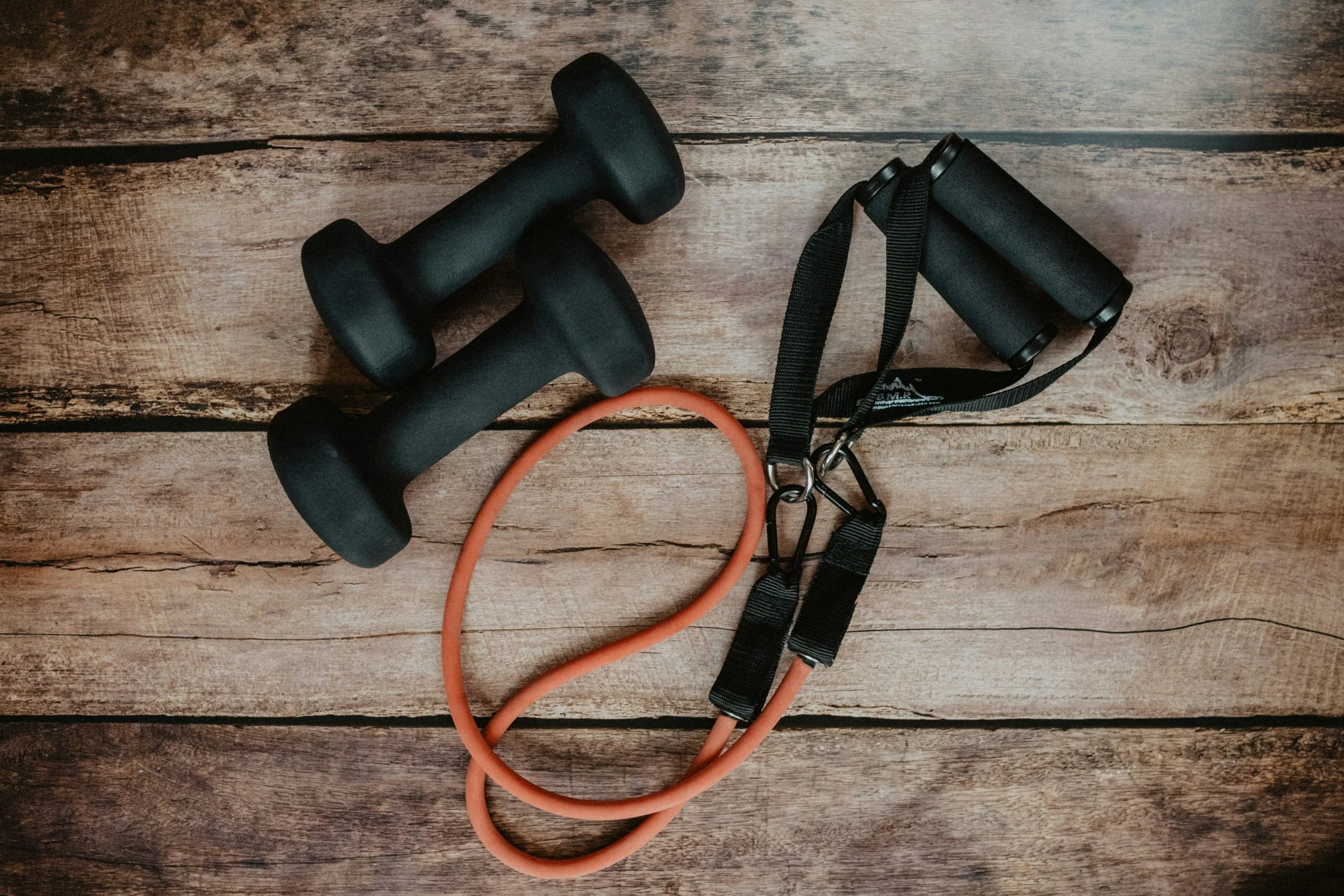
Now, I typically get this question from people who are looking to add a few pieces of gym equipment to their house without breaking the bank or leaving a footprint too large for their home. Finding what is best for you is going to largely depend on the type of exercise you enjoy and the amount of space you have. I am going to cover 5 pieces of equipment that have incredible versatility, do not break the bank, and are easily stored. These are not in any particular order. Each is important to a different aspect of your wellness and are considered “Home Gym Essentials” in my book.
1st Piece: A set of resistance bands with handles. $20 (LINK)
This is definitely the easiest item to obtain with the most uses. The linked set of resistance bands are what I use to train all my clients. With this item you can work out each muscle group of the body with enough resistance that as a 31 year old male who is 6’ 2” 230lbs and has been exercising seriously for 10 years, I still am able to utilize these in my workouts effectively with difficulty.
2nd Piece: Kettlebell 25-35lbs - $1lbs ~$50 for 2 kettlebells
Kettlebells are a great piece to include in a workout as they build strength, balance, coordination, proprioception, and mobility. They are only limited by your creativity with movements. They typically run about $1-2/lbs making the lighter ones easy to obtain where heavier kettlebells require more of an investment. A single 25-35lbs kettlebell can provide a brutal 30 minute workout for the whole body.
3rd Piece: Walking/Running Shoes $100-160
This is one of the more expensive items on the list. A good pair of running/walking shoes are crucial. Walking is the easiest way to exercise. Anyone who is anyone knows that a good pair of shoes makes a world of difference. You feel it in each step. There is also the recovery aspect of walking that is heavily underutilized. Walking pumps blood through the body quicker, blood carries nutrients throughout the body, as well as shuttles away waste away. 2 things that are crucial to the recovery process. Walking also helps with digestion, lowers blood pressure, and helps reduce blood sugar spikes when taken directly after meals. Never underestimate the power of a good walk.
4th Piece: 5-25lbs dumbbells - $1/lbs
Dumbbells are a tale as old as time. One of the most iconic pieces of exercise of all time. And for good reason. Like the bands, dumbbells versatility, without taking up too much space. I specifically wrote 5-25lbs for a few reasons. One, because the lighter weights are cheaper coming in at $1-2/lbs. The second however is because most dumbbell exercises that are effective for general fitness and wellness rarely exceed 30lbs for the average individual. Heavier ones are great to have but they exceed the scope of this article which is ‘Need”.
5th Piece: Foam Roller - $15
Recovery cannot be neglected. No matter how careful you exercise and how great you are, without recovery, eventually you’ll break somewhere. The foam roller is a great tool for something called ‘self-myofascial release’ which is the practice of providing pressure to the muscle in order to coerce the myofascia (connective tissue around muscle) to release and to promote blood flow to the pained area. In addition to that, it also can be used for stretching and as a balance tool.
With these items, a sustainable, and effective workout can be created for most any person who would like to workout at home and not spend a bunch of money. The key to successful exercise is of course consistency and hard work. But lets understand that accessibility is a huge help is staying consistent.

How long should I be exercising? And when is the best time to exercise?
If you read last week’s answer to the question, ‘How many days should I exercise?’ I partially answered this question in short, but I would like to extrapolate on the factors that will help determine this answer for you.
The short of the matter is that purposeful movement should be an everyday occurrence. Making exercise a part of daily life will build the routine quicker and provide more consistency to daily life. That is the secret. The fantastic mystery that everyone is looking to solve. The keys to success are in consistency. Doing the workday in and day out. That should be the foundation for all exercise routines that one can adhere to. Having a base of daily movement is the initial inertia needed to start compounding success. From there we can build to the more focused task of improving our health, building strength and muscle, and/or acquiring new skills.
So, how much time do we spend on all this? Like all health and wellness articles say, “It depends.” It depends on the answers to some questions we need to ask ourselves. Because we all have different goals and priorities in life, someone looking to improve their marathon time is going to spend their time differently than someone who is looking to improve their health so they can spend more time playing with their grandkids. The When and How Long are different. So what questions can we ask ourselves to find the right time to exercise and what are the most common times for people to prioritize their exercise.
· What is my main health goal? Do not answer, “I want to lose X number of pounds” or “I want to get stronger.” We need something more long term and closer to the heart
· When do I have 20 minutes free EACH day at the same time or close to the same time?
· How important is your health to you? Now, ask yourself if your time management reflects this answer.
· What access do I have to exercise equipment?
· What do I know about exercise? Do I need guidance or help with the physical act of exercising?
If you take a look at these questions, you are self-assessing your experience level, and determining where physical fitness falls on your list of things most important to you. Once you know that answer you can start laying the foundation on how much time you can happily spend on physical fitness.
One huge failure point for a lot of individuals is that their priorities do not align with their fitness goals, so time becomes hard to find. But, if you answered the questions I posed above, and you have determined where fitness falls on your list of things most important to you, finding the time could be as simple as cutting out your doom-scrolling, or watching a bit less TV or it could come with more difficult decisions like giving up time with family and friends. When it comes down to it, how important is being healthy to you?
Now that we have the mental planning complete, we have a rough idea of how much time we are able to spend exercising, based on the idea of how important it is to us and how ambitious our goal is. So, the 2nd half of this week’s question comes next, when is the best time?
The best time to exercise during your day is going to be the most routine times in your schedule. There is no way for me to know when the best times to exercise are for you. Morning, noon or night, it does not matter. Pick the time of day that you feel the best, and enjoy the process!

How many days should I be exercising if I want to live a healthier life?
This is the first question someone should ask themselves when considering their workout routine. Unfortunately, a lot of people do not get this question right. Instead, a lot of people give the hopeful answer, the answer they think they should adhere to. Typically, I hear 4-5x a week. And for some people that is sustainable, but it is likely that physical exercise ranks high on their list of priorities and they enjoy it already. But for the majority of people it’s at this point, failure is inevitable. The time commitment is too much. When you ask yourself this question, brutal honesty needs to be considered, and a few variables need to assessed to get this question right for yourself.
· Do I have any consistency in my schedule?
· What days have the least chance of surprise events and interruptions?
For many people this is only 2-3 days a week. Weekends are typically different week to week, Fridays for most are hit or miss, and typically 1 other day of the week is used for life tasks like groceries or family time or something else. This obviously does not apply to all people, but the thought process remains the same. A schedule that is harder to break is easier to follow.
Realistically most people in this world have about 2-3 good days a week where they can get in a solid chunk of time (1 hour or more) for exercise. While this is a good sustainable relationship with exercise on paper, this does leave 4-5 days of inconsistency and lack of movement. How can one expect to get a true hold on their exercise routine when most of their days do not include exercise?
I’m sure you might be able to see where this is going. You need to do some sort of exercise EVERYDAY. I will go over the smaller details in next week’s question, “How long should I be exercising (and when)?” but the TLDR is that we are creatures that need to exert ourselves each day in order to thrive. It can be as simple as a 20-minute walk outside, a quick kettlebell routine, a bike ride around town, anything really as long as you are moving with purpose.
Building out your week’s exercise routine will be unique to you, but it should contain the rough outline of: quick daily movement, 2-3 intense workouts (45-60min). For a working person this should be enough to maintain a healthier lifestyle without it being too overwhelming.
How I Got Introduced Into Fitness
How I got started with fitness and what it means to me.
I have found that a lot of the passions that I have in life, that feel true to my core, and that I can remember, were introduced to me during my elementary school years. As a kid sports were a large part of my life. I was introduced to wrestling at the earliest age of about 4 or 5, then soccer & t-ball, football followed around 3rd grade, baseball shortly after and then finally track & field. Activity was always around when I was young and that was where I made a lot of my life long friends. My association with fitness has always been a net positive for me but it is not the main reason why I choose this as my profession.
I grew up in a smaller town in West Michigan with both of my parents being public school teachers within the school system that they grew up in. And where my grandfather also taught. My father was a varsity wrestling coach first and foremost, a varsity football coach, and a varsity throwing coach for the track and field team. Hopefully you can picture the amount of time and attention that was committed to sports, coaching, teaching and community involvement. Over the course of my childhood, I heard about all types of kids that my parents taught, and all types of parents they had to deal with as teachers and my father as a coach as well. If you were wondering what teachers talked about outside of work, to their friends and too each other, its usually about the kids they are teaching. The good and the bad.
I’ve heard about kids overcoming immense obstacles, kids missing opportunities, parents being helpful, and parents being the problem. They would always discuss how they could help, provide support, how they could celebrate wins for their students and give praise to the parents. I could give thousands of examples here, but we will save those for another time. This was what I grew up hearing my entire life up until I moved away to college. But, throughout those years between then and now a past student more often than not, would seek out my parents and tell me how much their teaching or coaching helped them in other aspects of life. The joy on each face was impossible to miss and it always left an impact on me.
I chose personal training to continue on with that tradition of helping others realize the potential that they have in their life, and how having an active and mobile body can be a major advantage when it comes to living out a fulfilling life.
The motto of StoelenStrength is “Taking Back Control” You were given a body when you were brought into this world and to use it as a tool to make an impact and steer your own ship. I want to carry on the tradition of helping others steer their own ships and succeed in what life they want to live.

What has Fitness Given Me?
It all begins with an idea.
This post could be a mile long and I would still not be done writing. I won’t bore you with the details of everything and keep this list short to the 5 things that fitness has given me.
My Wife - Exactly this. My partner in life was introduced to me through mutual friends(just another addition for my 3rd reason) and our shared passion for fitness, health and wellness and helping others is what blended our lives together. Fitness has given me someone who has a love for all life has to offer and someone who has the energy and zeal to pursue it with her mind, body and soul.
My family - With my dad being my coach in all of my sports growing up, and his dad being a coach as well and having 3 siblings who played sports, we all shared each others wins and losses. Those moments of shared experience brought us closer together as a family and something I will cherish for the rest of my life.
My Friends - A lot of the friendships that people have growing up can be the most impactful on our lives down the road. Whether those friends are a constant in your life, transient or have fallen away they leave an impact on us. My closest friends are people who I played sports with as a kid and have grown alongside. While not all of my friends hold fitness as close to their hearts as I do, those hours spent on the field, or the mat together shaped how we handle adversity and taught us how to work together as a team and lean on one another.
Opportunity - By prioritizing my health and wellness there are more opportunities available to me in this world. More energy to play with my nieces and nephews, more options for traveling, more opportunities to help others.
Discipline- Always save the best for last. Health and wellness requires a certain amount of work and commitment. There are no exceptions to that rule. Some people it may come more naturally but it requires daily conscious thought to execute consistently. This carries over to all other aspects of my life and it encourages me to be better each and every day. The days that come to everyone where you aren’t quite sure what to do, you’re feeling lost, upset, angry, or unmotivated to do better; when you give effort to your physical health the desire to carry that success and progress to other areas of your life comes more readily available. Being disciplined on my physical health allows me to focus on how I can be more disciplined in my work, my family, my community, and my mental health.